
- 1. Understanding SB 326: California’s Balcony Bill and Inspection Laws
- 2. What Is SB 326?
- 3. What Are Exterior Elevated Elements (EEEs)?
- 4. SB 326 Inspection Requirements
- 5. What Must Be Inspected?
- 6. What Must Be Included in the Inspection Report?
- 7. Common Inspection Methods Used
- 8. What Happens If You Don’t Comply with SB 326?
- 9. Insurance and Liability Implications
- 10. SB 326 vs SB 721: Know the Difference
- 11. Key Compliance Steps for HOAs
- 12. Why Professional Management Matters
- 13. Why Choose BFPM for SB 326 Compliance Support
- 14. The Bottom Line
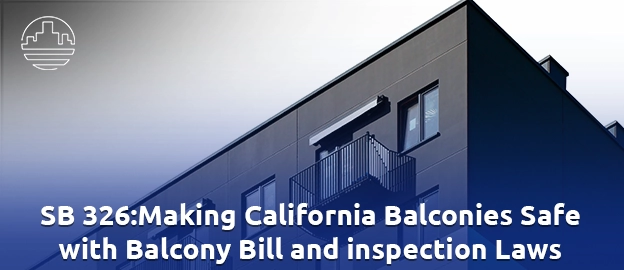
Understanding SB 326: California’s Balcony Bill and Inspection Laws
In 2015, a tragic balcony collapse in Berkeley, California resulted in multiple fatalities and serious injuries. The incident exposed structural failures in exterior elevated elements and led to stricter statewide safety regulations.
In response, California enacted Senate Bill 326 (SB 326) in 2019, commonly known as the California Balcony Inspection Law.
If you manage or own multifamily properties governed by a homeowner’s association (HOA), understanding SB 326 is critical to avoiding liability, penalties, and insurance complications.
Here’s what you need to know in 2026.
What Is SB 326?
SB 326 requires periodic inspections of specific structural components in certain multifamily residential buildings.
The law applies primarily to condominium associations and HOAs responsible for maintaining exterior elevated elements (EEEs).
The purpose is simple:
Identify structural deficiencies before they become dangerous.
What Are Exterior Elevated Elements (EEEs)?
SB 326 focuses on EEEs that meet all of the following criteria:
- Located six feet or more above ground
- Made primarily of wood or wood-based materials
- Designed for human occupancy or load bearing
- Includes balconies, decks, walkways, stairways, and landings
If a building contains these elements and is governed by an HOA, it is likely subject to SB 326.
SB 326 Inspection Requirements
Initial Deadline
The first inspection must have been completed by January 1, 2025.
If not completed, the HOA is already out of compliance.
Ongoing Inspection Cycle
After the initial inspection, inspections must occur every nine years.
These inspections align with reserve study cycles, typically coinciding with every third reserve study.
Who Can Perform the Inspection?
Inspections must be conducted by:
- Licensed structural engineers
- Licensed architects
Licensed general contractors may assist, but a licensed architect or engineer must oversee and certify findings.
Inspectors cannot perform repair work on inspected components to avoid conflict of interest.
What Must Be Inspected?
Inspectors must:
- Visually inspect a statistically significant sample of EEEs
- Evaluate load-bearing components
- Assess waterproofing systems
- Identify signs of rot, decay, or moisture intrusion
- Determine structural integrity
If immediate danger is identified, the inspector must notify:
- The HOA board
- The local building department
Emergency hazards require immediate action.
What Must Be Included in the Inspection Report?
The final report must contain:
- A list of inspected elements
- Description of physical condition
- Statement regarding safety risk
- Estimated remaining useful life
- Recommended repairs
- Classification of repairs as emergency or non-emergency
The report must be:
- Incorporated into the HOA’s reserve study
- Retained for at least two inspection cycles
Proper documentation is critical for legal protection.
Common Inspection Methods Used
1. Visual Inspection
Inspection of exposed surfaces, guardrails, framing, and attachment points.
2. Endoscopic (Borescope) Inspection
Small holes are drilled to inspect concealed framing without major demolition.
3. Moisture Testing
Moisture meters detect water intrusion, which can lead to dry rot and structural decay.
4. Infrared Imaging
- Used to identify temperature variations indicating potential moisture or structural issues.
- However, infrared cannot see through dense materials like stucco without access points.
What Happens If You Don’t Comply with SB 326?
Failure to comply can result in:
- Enforcement actions by local building departments
- Fines and administrative penalties
- Recovery of enforcement costs
- Liens placed against the property
- Increased exposure to personal injury lawsuits
More importantly, insurance carriers may:
- Deny claims
- Increase premiums
- Refuse coverage renewal
If someone is injured due to structural failure and inspections were not completed, the HOA may face significant financial liability.
Insurance and Liability Implications
Insurance carriers increasingly require proof of SB 326 compliance.
Without proper inspections:
- Personal injury claims may not be covered
- Directors and Officers liability exposure increases
- HOA boards may face personal liability risks
Compliance protects both residents and board members.
SB 326 vs SB 721: Know the Difference
It’s important not to confuse SB 326 with SB 721.
- SB 326 applies to HOA-governed multifamily properties (condominiums).
- SB 721 applies to rental apartment buildings with three or more units.
Both laws require elevated element inspections, but compliance standards differ.
Property managers must verify which statute applies.
Key Compliance Steps for HOAs
To remain compliant:
- Confirm whether your property qualifies under SB 326
- Engage a licensed structural engineer or architect
- Complete inspection and obtain written report
- Address emergency repairs immediately
- Budget for non-emergency repairs
- Update reserve study documentation
- Maintain records for at least two inspection cycles
Proactive planning prevents rushed emergency expenses.
Why Professional Management Matters
SB 326 compliance involves:
- Coordinating inspections
- Providing documentation
- Tracking deadlines
- Managing repair timelines
- Budget planning
- Communicating with residents
Failure at any step can create financial and legal exposure.
Why Choose BFPM for SB 326 Compliance Support
At Beach Front Property Management, we assist HOAs and property owners across Los Angeles, Long Beach, and Southern California with SB 326 compliance coordination.
Our team helps by:
- Scheduling licensed inspections
- Coordinating access to units and EEEs
- Managing documentation
- Updating reserve studies
- Overseeing repair timelines
- Ensuring compliance deadlines are met
We act as the operational bridge between engineers, boards, vendors, and residents.
The Bottom Line
SB 326 was enacted to prevent structural failures and protect residents from preventable tragedies.
If your HOA governs a property with exterior elevated elements six feet or higher, regular inspections every nine years are mandatory.
Non-compliance can result in fines, liens, legal exposure, and insurance complications.
Compliance is not optional. It is a safety and liability safeguard.
If your association needs assistance coordinating inspections, managing repair timelines, or ensuring ongoing compliance, contact Beach FrontProperty Management to review your SB 326 obligations and property management strategy.

Trevor Henson
Trevor Henson is an experienced entrepreneur (10+ highly-successful start-ups) and property investor with a demonstrated history of building and leading teams in investment property management environments, maximizing returns for property owners, and optimizing properties through construction management and re-positioning. He…Learn more about how we can help. Customized solutions for large portfolios!